Sunday, 17 March 2013

Babar

Babar is about an elephant who, after his mother is killed by a hunter, leaves the jungle and enters the city, where he learns about civilisation. He returns to the jungle, wiser, and becomes the king of the elephant kingdom. This book has been heavily criticised for attempting to justify colonialism. The writer Adam Gopnik, in his article Freeing the Elephants, thinks that the book is more about the lure of organised civilisation, and the safety and easiness of it, is something that elephants can feel too – “"while it is a very good thing to be an elephant, still, the life of an elephant is dangerous, wild, and painful. It is therefore a safer thing to be an elephant in a house near a park.""

Little Black Sambo


A children’s book first published in 1899, which has been revised many times as black people have gained more equality over the course of the 20th century. Sambo is an indian boy who meets some tigers while he’s on a walk, and gives them his clothes in exchange for them not eating him. The tigers argue over their new clothes, and melt into butter. The caricature of a black child was hurtful to black children who read it, and as early as 1932 it stopped being recommended to school children. The book has been remade and rebranded by many writers and illustrators, who have changed it to names such as “little kim”, “the boy and the tigers” and “chibikuro sampo” (a Japanese version, which translates to little black sambo). 

Matilda


The distinctive illustrative style of Quentin Blake shows the story of a little girl who is neglected by her vile parents, and develops telekinetic psychic powers. Quentin Blake said in an interview that his informal style makes his works more approachable, encouraging children to engage with the books. The illustrations of her sitting by piles of books, smiling, particularly speaks to shy, bookish children, who feel that books are their only friends, and lets them know that it’s okay to be like that. Matilda is a brilliant example of a female main character in a book aimed at both girls and boys, something that is surprisingly rare in child-oriented media. 

Paintings of Venus


Venus is the roman goddess of love, sexuality and fertility, being the human embodiment of these things.
She has been painted a lot and here I have looked at two paintings of her, by Titian and Manet. This is Venus of Urbino, a painting by Titian from the 1500s.


 She is inside, a change from her usual depictions (she was born from sea foam so she is often in the sea), and she is looking directly at the viewer, engaging with them. As well as this, the painting is erotic, her body language being inviting and relaxed. However, the dog in the background is a symbol of fidelity, and her hand is delicately hiding her vulva as her servants search for clothes in the background.


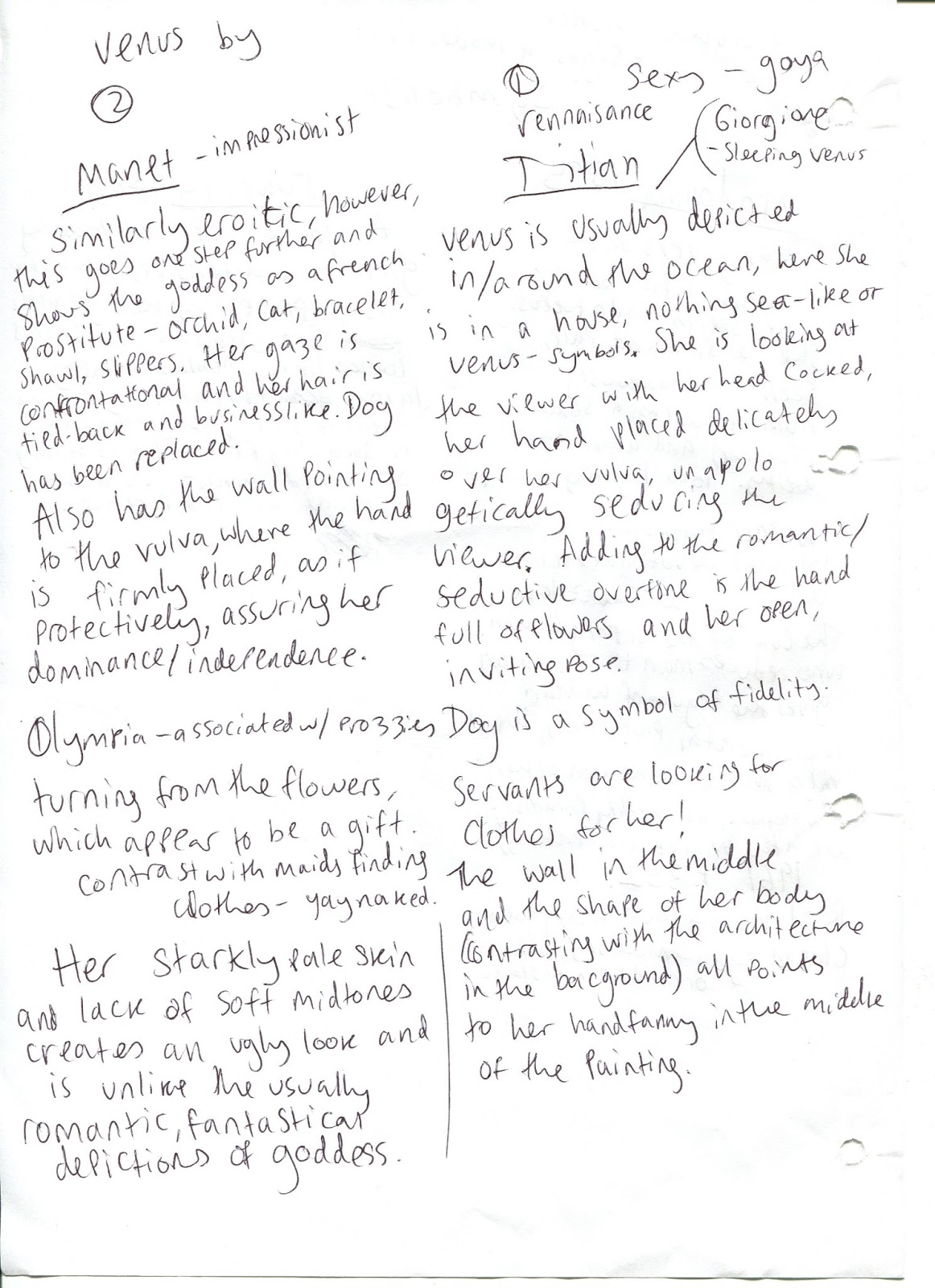
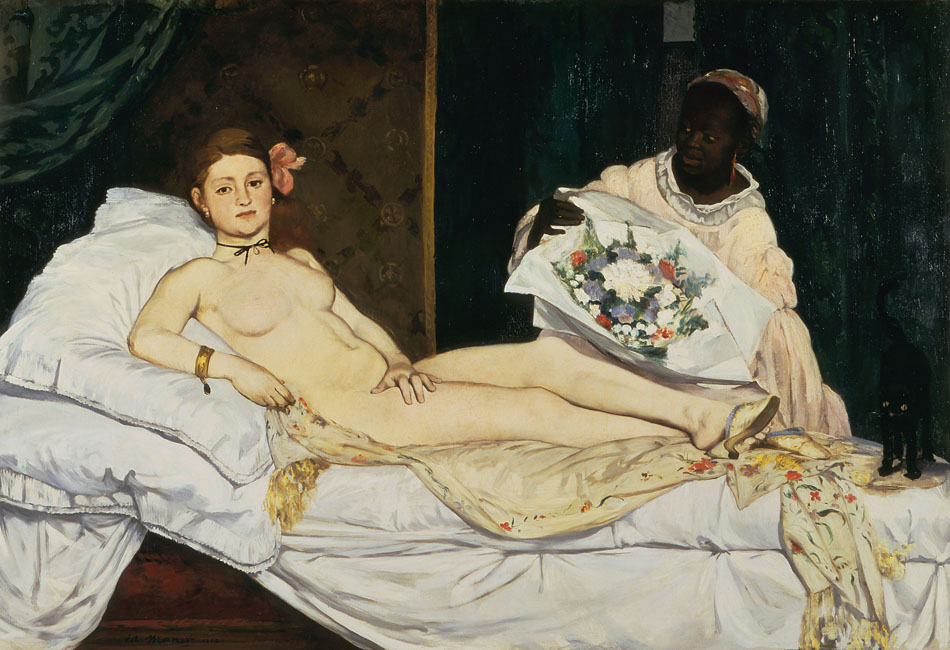
 In the Manet painting, which is inspired by Venus of Urbino, she is depicted as a French prostitute, wearing high heeled shoes, an orchid in her hair, a bracelet, pearl earrings, and other things. This also has some marked differences in that the animal depicted is a cat, another indicator of prostitution, and her hand is firmly placed over her vulva, as she looks away from a bouquet of flowers, likely a gift from a client. This painting is also very sloppy and lacks midtones, which was shocking at the time, as it depicts a harsh and sickly goddess, rather than a beautiful fantasy. 

Wednesday, 30 January 2013

Lecture Notes - 30/1/13


The Hero In Children's Books

Warwick Goble – Jack and the Beanstalk
Teenager – often shown as young boy
Journey! - underprivileged, throughout journey completes tasks and transforms
Cultures have their own versions of this story
Fee fi fo fum etc
Has help given to him by the the giant's wife – a woman
Gold egg laying goose

Grimm's fairy tales are very dark, were cleaned up by the victorians
Roald Dahl tried to have dark stories

Gustaf Tenggren – Tom Thumb
Youngest of several children – seen as weak, has to prove his place in the family
Gets abandoned in the forest with bros and siss by neglectful parents
Retraces his steps using breadcrumbs
An ogre's house – ogre smells fresh meat, very primal/otherworldly?
Takes the ogre's boots – contain some of the ogre's power
Child may be too young to understand some of the deeper themes and meanings
Tom rescues the ogre's daughters, gets help from ogre's wife (a mother figure).
There are good people or bad people, no in-between.
Goes through a transformation to a powerful character

Ed Bryan (Nosy Crow Publishers) – Cindarella
Female characters are usually weak or victims – cindarella is a rare female protagonist.
Step mum and sisters are jealous of her beauty and turn her into a slave.
Ahead of its time, containing a blended family which is a contemporary story theme.
Passive – waiting for her prince to come and rescue her.
Links between this and matilda – nasty family who doesn't appreciate her. Matilda is an empowered child who saves herself, however.

Ann Sexton – feminist poet
Guardian article by Adam Philips who points out that the fairy godmother is the person who helps, and the people holding cindarella back were female.

Winnie Fitch – Red Riding Hood
Nobrow and 50-60s aesthetic. Lithography print. Working with texture and limited colour.
LRRH, hero, goes on a journey. The wolf is a metaphor for a sexual predator. Very contemporary issue. Predatory man.
Red is associated with sexuality and passion, her journey is into puberty (woods are the unconscious, where one becomes more mature and knowledgable).
Red hood is a symbol for a prostitute, in 1700 France in particular.
Is rescued at the end by the woodcutter, but in some older versions she does not get away.
Gustave Dore illustration of her in bed with the wolf.

Herge – Tin Tin
Young reporter, in comic books, based on Herge's ideas as an inventor. Snowy the dog is his companion. Has freedom to travel anywhere, has no family.
Scott McLeod – tintin stories allow readers to mask themselves with tintin and allow themselves to safely enter a sensually stimulating world.
Tintin is a gentleman. Always comes out on top.

W.E. Johns – Biggles
Stories about a pilot's adventures, graphic novel. As he grows and matures, his role changes. Becomes an astronaut. Authority from the author's life as a pilot

Where The Wild Things Are – Maurice Sendak
Sent up to bed, bedroom becomes a jungle. Child (Max) goes through transformation. Much smaller than the animals he finds, who are a metaphor for either parents or the child's unheard anger. Child has power over these Wild Things. Overpowers by staring at them. He is their king. Way for a child to work out anger. Banned from many school libraries for a while because they were seen as encouragement to disrespect parents and authority.

John R Neill – Little Black Sambo
Racial stereotypes were normal in the 60s. Cultural terms, were used without question. Character is very powerful, negotiates with lions to avoid being eaten. Gives them his umbrella and clothes. They fight over the clothes and turn into butter...
C Carey Cloud, 1934 – same book, character is a caricature of a black person. Black face and red lips.
Story of Little Babaji – Fred Marcellino – updated version, looks more like a real life child who lives in India.
Barefoot Book of Earth Tales – Anne Wilson

Devon and Cornwall are so white.

Elephant Dance – Sheila Moxley
Stories about british child's heritage in a different country/culture. 1st/2nd generation immigrants.

Mia's Story – Michael Foreman
South american girl in extreme poverty. Dad brings home a small dog, who escapes and runs into the mountains, so Mia goes into the mountains on a horse to find the dog. Finds pretty stuff, white flowers (symbol of hope). Comes from a difficult background, and sees that things are hopeful and nice if you want them to be.

Pretty Salma – Niki Daly
African LRRH story. Meets wolf on the way to market. Manages to outwit him, positive female character.

Lost and Found – Oliver Jeffers THERE'S AN ANIMATION
Story about friendship between a boy and a penguin. Takes the penguin home but misses him.

Babar – Jean de Brunhof
Babar is a normal elephant in the jungle, and is camptured, acquires clothing and learns to stand upright, metaphor for colonialisation. Ariel Dorfmann has written a scathing critique of this book and what it represents. Herbert K Kohl and Vivian Paley also thought it was offensive and tried to defend colonialism.
The Empire's New Clothes (Dorfmann) has also written about donald duck and mickey mouse.

BeeguAlexis Deacon
Story about an alien, representing an outsider, for weird children to identify with when they don't feel they belong to a group. She looks weird because she's an alien, but eventually finds some friends who accept her. Eventually, her mother comes to find her and save her.

Melrose and Crock – Emma Chichester-Clarke
A sausage dog and a crocodile being friends lol

Charlie and Lola – positive female character, story about a brother and sister being friends aww

Wizard of Oz – WW Denslow
Dorothy is a strong female character – archetype of good witch and bad witch, represent good and bad mothers. Children can't see people as both good and bad, have to be one or the other.

Stone Girl Bone Girl – Sheila Moxley
Story about a rare female archaeologist, disproving the creation myth.

Pippi Longstocking – Lauren Child (charlie and lola lady)
Strong fem character for the time she was made, reimagined by lauren child. Does boy things, is assertive and has superhuman strength. Saves contempt for pompous adults. “strength of ten policemen” but is not violent.

Matilda – Quentin Blake

Tuesday, 22 January 2013

Noma Bar

Noma Bar was born in Israel, 1973, and studied graphic design & typography at Jerusalem Academy of Art & Design. His caricatures are often commissioned for editorials, such as magazines, and has been shown on TV. I have an interest in political and editorial illustration, and his portraits of political figures are incredible.


This image of Osama Bin Laden was a personal piece, as he would not be allowed to use this kind of imagery for a commission. This demonstrates the power in his work - nothing more than blocky shapes was considered by the artist to be too shocking. His work also shows fluent use of negative space - the relationship between the turban and the towers is invisible, but seen by the viewer through the suggestion by the shapes and what we expect from the person's face.


This image of Margaret Thatcher, at the time the leader of the Conservative Party, describes the internal struggle the party was experiencing at the time. The party was previously known as the Tory Party, with a flaming torch as its logo. Bar used this retired logo as Thatcher's nose, and edited it so the flame is smouldering in the image. The incredibly simple graphics carry a lot of meaning, and considering that Bar grew up in Israel, describes the politics of a foreign nation excellently.


I enjoy the simplicity of this image, which does not contain any conflict, simply marrying together two concepts (night and sleeping) for an easy-to-digest image about the broad subject of sleep.

Sunday, 20 January 2013

Lecture Notes - 16/1/13

"What links can be made between contemporary illustration, art history and past culture?" - essay question
Ideas

  • Editorial/political illustration - Steve Bell, Trog, etc
  • Small press illustration - Nobrow, B9, zines, etc
  • Animation - films, shorts, stop motion, 3D/Pixar, etc
List of mentioned illustrators

  • Spike Gerrel
  • Glen Baxter
  • Paul Blow
  • Edel Rodriguez - oppression
  • Brad Holland - metaphor
  • Ian Whadcock
  • Brian Grimwood - postmodernist
  • René Magritte - surrealist
  • Jung, Freud 
  • Abram Games - propaganda
  • Matthew Cook
  • Laura Carlin
  • Victor Ambrus - history, folklore
  • Laura Knight
  • Russell Cobb - anatomical, decorative, informative
  • Craig Foster - DNA
  • Peter Grundy - infographics
  • Harriet Russell - map 
  • Ravenna Mosaics - Jesus
  • Greek pots - tell stories
  • Hokvsai - printmaker
  • John Singer Sargent - fashion
  • Aubrey Beardsley 
  • Moebius
  • Asaf and Tomer Hanuka
  • Windsor McCay 
  • Bayeux tapestry - 1066 Battle of Hastings - sequence
  • William Hogarth - first political cartoonists, Gin Lane
  • Peter Brookes - political cartoonist
  • Foz - grafitti
  • French cave paintings
  • Lucy Mclaughlan
  • Charlotte Mann - backdrops
  • Krisjana Williams
  • Sara Fanelli
  • William Morris - surface designer
  • Kathe Kollwitz - WW2 printmaking
  • John Tenniel - 1800s, Alice in Wonderland
  • Kathy Greenway - sweet, sickly paintings of children 
  • John Martin 
  • Jogn Minton
  • Chaucer
  • Eva Tavecha
  • Russell Cobb


Internet - illustrations happen there
Can be defined by conceptual approaches or recognised by genre and area of application.  Illustration is getting more popular. Sometimes defined by stylistic approach (we're taught Bauhaus style).
Images can be used to convey information
Propaganda - Russian constructivism, communists, bold graphics, colour, impact

Illustration can be narrative or text based to document sequences. Reportage, topographical illustrations.
Documentation can take different forms - pictograms. Psychogeography.

Image and text - sequence and movement.
Illustration as a social tool - influencing politics as social history. Application influenced by technology and politics/social sitch. Function of illustration is linked historically.

Research 5 artists.

Sunday, 25 November 2012

Hannah Höch


A German Dadaist photomontage artist who created work inspired by feminism and beauty, based on her job working for a women’s magazine in Berlin. She was belittled by other Dadaist artists for being a woman, and described as her contributions being the food and drink she provided the artists, despite being a pioneer in the development of the movement. She would create art that subverted womens’ status as second-class citizens, including making brides into mannequins and creating androgynous characters.
Her powerful photomontages and use of collage to incite social change were why I chose to research this based on my current (loose) theme – german expressionism and collage. 

Wednesday, 7 November 2012

Johannes Itten

Itten was a teacher at the bauhaus and introduced a foundation course, where he would encourage students to nurture their creative process before starting studies in their chosen art. They would learn his colour theories and create work out of mundane and geometrical objects, not unlike Schwitters' collages. Itten is credited with introducing the idea of a foundation course for all art students, something still used now. He used progressive and experimental teaching methods, including refusing to correct mistakes and playing music to begin a class, based on his previous job as an elementary school teacher. This caused him to be scolded by his colleagues in the bauhaus and he left in spring 1923. He went back to teach children.


"on the whole there is nothing wrong and nothing right, it simple lives and materializes through the interplay of forces..."
- Paul Klee

refs
"bauhaus" arranged by Wurttembergischer Kunstverein Stuttgart (book accompanied a gallery exhibition of bauhaus work)

Wednesday, 31 October 2012

Mark Hearld

A printmaker I found in an illustration journal. His work is beautiful and I will be buying one of his books.

A Softer World

A Softer World is a collaborative webcomic between novelist Joey Comeau and photographer Emily Horne. It's a very dark comic, and is presented in a collage-like style. The photographs and the text aren't always obviously connected, and often appear as if they're from the perspective of the person the text is from, looking from one thing to another (as the images often repeat, zoomed in/out or panned.
While the comic is usually very sombre and depressing, this is often mixed with humour to make the reader feel uncomfortable. Each narrative in each comic is completely disconnected and out of context. It reminds me of Joseph Cornell's boxes - each comic is its own little world. The characters in the comic are usually creepy, criminal, (often referring to murder and stalking) and secretive. At the same time, it can be twistedly romantic.

Joseph Cornell & Kurt Schwitters

Joseph Cornell was a surrealist artist who had no formal art education and worked primarily by filling boxes. 
He would go to new york thrift shops, and various other places, and collect items he liked. Much of this was victorian bric-a-brac and was collated in his boxes, often with a glass pane on the front. They often gave their own narrative, and the items used in a box were carefully selected (for example, untitled (pink ballet case) consisted of small fake rose petals, a strand of glitter, sea shells, lace, and pot pourri (I am only guessing this from an image). The items are all connected by fragility and simple beauty, much like a ballet dancer. 

Kurt Schwitters was a german artist who began collage when he went to berlin and became involved with the dadaists. He picked up rubbish such as bus tickets and newspapers and created collages with them. He also created poems from overheard conversations. He began the Merz movement, which he said meant "reject" or "refuse". He said that waste materials had just as much validity as paint as artistic tools. 

These two artists take the idea of collage and subvert it, Cornell creating 3D collages and Schwitters creating philosophically driven collages, from the idea that all items are art materials. The student who I interviewed created a collage from items he found in his late Grandfather's house. 


Thursday, 25 October 2012

The Cabinet of Doctor Caligari

I watched this film earlier, and immediately, the visual style caught my attention. The jagged buildings and wonky sets show that nothing is as it seems, and that reality is warped, which makes perfect sense at the end when the twist is revealed. I particularly liked the shot of the fairground, with the crowds of people and the diagonal merry-go-round.

It's clear from how the shots are set up that this is made right at the start of the genre being established, as it was like a theatrical play had been filmed from the perspective of the audience for many of the scenes, breaking this pattern by zooming in to characters' faces. The makeup is also interesting, as it's like the big, black smudges under Cesare's eyes and Caligari's nose are there to emphasise certain facial characteristics and expressions. Cesare has big black smudges under his eyes to show that he has problems with sleep, for example.

Next, I'll watch Nosferatu, which I thought would be appropriate for halloween next week.

Wednesday, 17 October 2012

Sophie Scholl

I've been reading about Sophie Scholl, a german student and political activist during the holocaust. She and her friends from the University of Munich, a group known as White Rose, were caught distributing their anti-nazi leaflets in 1943 and were executed by beheading. She kept up her political dissent to the end, and bravely walked to the executioner, believing she and her friends had taken the first step to bringing down the nazi government.

I shall be taking inspiration from Sophie Scholl's short life for my own work, particularly the character I am working on in class. To be so boldly outspoken against something you know you will be killed for disagreeing with is incredibly brave and noble.

Scholl was also interested in the arts, particularly degenerate art (what the nazis labelled anything they didn't approve of, such as post-impressionism, expressionism and dada). I will be picking up a book about 20th century german art in the library, and I will look to watch The Cabinet of Doctor Caligari.

WHO PUT BELLA IN THE WYCH ELM?

An incredibly interesting creepy unsolved mystery from my area, the midlands. 

I'd like to create some art based on it, particularly in light of halloween.

Tuesday, 16 October 2012

Hvass & Hannibal

Hvass & Hannibal (Nan Na Hvass and Sofie Hannibal) work from a studio in Copenhagen, Denmark, where they have created illustrations since 2006. Their use of colour and their compositions are very playful yet neat and organised. The piece I saw in the Making Great Illustration exhibition is an album cover, which is incredibly bright and colourful and looks very tapestry-like. If I remember our tour correctly, it is made of fabric stitched together. It is amazingly intricate and, after learning the basics of composition in the studio the other day, breaks the rules fantastically.

Wednesday, 10 October 2012

What even is this blog

I'm a first year illustration student at Plymouth, and instead of having a research journal made of paper, this is one made of pixels. It saves the trees.